
eBay reselling in the UK means buying things for less than they sell for on eBay, then listing them there yourself. For a beginner it is the most forgiving place to start: the buyer base is the widest of any UK marketplace, it covers every category rather than mostly clothes, and every listing that has sold is a price guide you can check for free. Start by selling what you already own, learn pricing from sold listings, and only then put money into stock.
This post covers the first month: account type, what to sell first, where stock comes from, how to price it, the listing details that matter, tax, and the mistakes that cost new sellers money. It is the eBay chapter of our guide to reselling in the UK. If you have never sold anything online, read the step-by-step guide to starting reselling first.
Why eBay is still the place to start
Vinted is faster for clothes and Depop has the fashion crowd; we compare all three in eBay vs Vinted vs Depop. For a beginner without a niche yet, eBay wins on three things.
- Reach. Buyers for almost anything, including people who will never open Vinted: the collector after one game, the parent replacing a lost controller, the tradesperson after a part.
- Categories beyond clothes. Electronics, video games, trading cards, LEGO, tools, car parts, homeware, job lots. If you know about something, there is an eBay market for it.
- Sold-price data. The Sold items filter shows what things actually went for, by condition. No other UK marketplace gives you that for free, and it is how you decide what to buy before you have bought anything.
The trade-offs: popular categories are crowded, returns happen, and once you are trading, business seller fees take a slice of every sale.
Private seller or business seller?
A private account is for selling your own belongings. Checked October 2026, UK private sellers pay no final value fee when an item sells (vehicles excepted) and get 300 free listings a month, then 35p a listing. Buyers on private listings pay eBay a buyer protection fee on top (a flat amount plus a tiered percentage, built into the price the buyer sees). You do not pay it, but it affects what buyers will pay you.
A business account is for anyone buying stock to sell on, which is what reselling is. Once you are past clearing your own cupboards, eBay expects you here, and it brings consumer-law obligations such as returns rights. Checked October 2026, business sellers pay a final value fee that varies by category (11.9% in Clothes, Shoes & Accessories, 9.9% in Video Games & Consoles, 10.9% in Collectables and in Toys & Games, most others between 9.5% and 14.9%), plus 30p per order up to £10 or 40p above that, plus a 0.35% regulatory operating fee. Listings cost 30p each without a Shop subscription.
Our advice: sell your own things on a private account for the first couple of weeks. When you start buying to resell, switch to a business account and build the fees into your buy price. Worked examples are in eBay fees UK explained. Fees change, so check eBay's official pages (in Sources) before relying on any figure here.
What beginners should sell first
The best first stock is what you understand, because knowledge is how you spot a mispriced item at a car boot. Beyond that, these categories suit beginners because sold prices are clear, demand is steady and postage is cheap:
- Trainers. Sold prices by size and style code are easy to check, and the gap between a clearance price and the eBay sold price is often £30 or more. Our Nike outlet guide covers the sourcing side.
- Electronics accessories. Controllers, chargers, headphones, cables and docks for devices no longer in the shops. Small, light and always in demand.
- Video games. Complete in box, especially retro titles and limited editions. Condition and completeness drive price.
- Collectables. Pokémon and other trading cards, LEGO, figures. Deep markets with well-documented prices. Our Pokémon at retail guide explains how members source cards.
- Bundles and job lots. Buy ten items as one listing, sell them as ten. The margin is in the split and the work is in the listing.
Avoid at first: anything fragile, heavy, impossible to verify as genuine, or priced by guesswork.
Where to source stock
Your own house. Free stock, zero risk, and the fastest way to learn listing and posting.
Charity shops. Learn two or three near you and visit on restock days. Check the sold price on your phone before you buy, every time.
Car boots. Early, with cash, in the categories you know. Bundles of games, boxes of LEGO and bags of cables go for pennies because the seller wants them gone.
Retail clearance and price errors. New stock from a retailer at a mistake price or deep clearance, sold at the market price. Bigger margins than second-hand, and more money needed. Members hear about these through our discount and price-error monitors across 50+ UK retailers, which in recent weeks caught adidas Ozweego at JD Sports priced at £4 instead of £95 (reselling at £40 to £55 a pair; one member took 270 pairs) and Nike P-6000 at £30 (reselling at £70 to £90). Retailers do cancel some price-error orders, so never count the profit until the parcel arrives.
Underpriced eBay listings. Sellers who do not know what they have list it badly: misspelled brand names, vague titles like "trainers size 9", "untested" electronics, sealed product at retail price. Those go to whoever sees them first. Our post on finding underpriced eBay listings covers the searches, and the eBay monitor is how members watch for them without refreshing all day.
Underpriced Vinted listings. The same idea on Vinted, where clothes and trainers are often listed below eBay sold prices. The Vinted bot surfaces new listings 4 to 7 seconds before they appear in the Vinted app, with one-tap autobuy; the free live Vinted monitor shows the feed working.
How to price using sold listings
This is the skill that separates people who make money on eBay from people who hold stock.
- Search for the exact item on eBay, with the model number, edition or style code if there is one.
- Open the filters and tick Sold items. You now see what buyers actually paid, not what sellers hoped for.
- Look at the last several sales in the same condition and completeness as yours. Ignore the highest. Price near the middle.
- Work backwards. Sold price, minus eBay's fees, minus postage and packaging, minus what you paid, is your profit. Under £5 is not worth your time.
- Set a maximum buy price before you go sourcing. Our rule of thumb for beginners: pay no more than a third to a half of the sold price, so the profit survives a slow sale.
Sold prices also tell you how fast something moves: twenty sales last month means a quick sale at the middle price, two sales in three months means you are holding stock. Members can shortcut step two with the Price Check command in our Discord, which returns the live average sold price by condition.
Listing basics that move the needle
Most new listings fail on one of four things.
- Photos. Natural light, plain background, every angle, and a clear shot of any flaw. Eight to twelve photos is normal. The first one gets the click, so make it the whole item, square on.
- Title keywords. You get 80 characters. Spend them on what a buyer would type: brand, model, size, colour, edition, condition. "Nike Air Max 90 UK 9 White Grey Trainers Boxed" beats "Nice Nikes, must see".
- Item specifics. Fill in every field eBay offers, because the search filters run off them; a listing with no size set never appears in a size filter.
- Postage choice. Weigh and measure before you list, pick a tracked service that fits, and decide whether to build postage into the price or charge it separately. Tracking protects you in a dispute. Dispatch within a day.
On format: Buy It Now with Best Offer suits almost everything a beginner sells. Auctions only make sense for rare or collectable items where competing bidders push the price up, and even then start them at a price you would be happy with.
The first month, week by week
Deliberately slow, because the expensive mistakes come from buying stock before you understand pricing.
| Week | Focus | What to do | Spend |
|---|---|---|---|
| 1 | Sell what you own | List 15 to 20 items from your house on a private account. Learn photos, titles, item specifics and posting. Check sold prices before pricing anything. | £0 |
| 2 | Research and first stock | Pick two categories you know. Read sold listings in each until you can guess prices. Visit two charity shops and one car boot with a maximum buy price written down. | £50 to £100 |
| 3 | List everything, same day | Switch to a business account once you are buying to resell. List every item within a day of buying it. Try Best Offer on half the listings and compare. | Reinvest only |
| 4 | Review and tighten | Note what sold, what did not, and why. Drop the weaker category and set up alerts for the stronger one, so sourcing stops depending on luck. | Reinvest only |
By the end of the month you should have made 20 to 40 sales, know one category well, and have a small pot of profit to reinvest. Our estimate for a beginner at this pace is £100 to £300 a month after fees once the routine settles, and nothing about that is promised.
Mistakes to avoid
- Buying before checking sold prices. The biggest cause of dead stock. Asking prices are not sold prices.
- Forgetting postage and packaging. A £12 item that costs £4 to post and £1 to pack has little left after fees. Price the whole chain.
- Listing slowly. Stock in a cupboard is money in a cupboard. List the day you buy.
- Ignoring returns. Tracked postage, honest descriptions and clear photos of flaws keep them rare.
- Scaling before the process works. More stock multiplies whatever you are doing. Make sure it makes money first.
- No records. Keep every receipt and a simple spreadsheet from day one; it makes the tax return a half-hour job.
Tax basics for eBay resellers
Selling your own unwanted belongings is not trading and is not taxed. Buying to sell on is trading. Every UK taxpayer gets a £1,000 trading allowance each tax year. Under it, you owe nothing and do not need to tell HMRC. Above it, you register for Self Assessment by 5 October after the end of the tax year (which runs 6 April to 5 April), and your return and payment are due by 31 January. Tax is on profit: sales minus stock, fees, postage and tools, including a membership like ours.
Separately, since 2024 eBay and the other platforms report sellers to HMRC once they pass 30 sales or around £1,700 in a calendar year. Being reported is not a tax bill; it means HMRC can see the income. Our side hustle tax guide covers the details, and the free side hustle tax calculator gives you a figure for your own numbers.
Where the eBay monitor and Vinted bot fit
Not in week one. Tools multiply whatever you are already doing. Once you have made a few sales and know a category, the limit becomes finding stock faster than everyone else, and that is where they earn their keep.
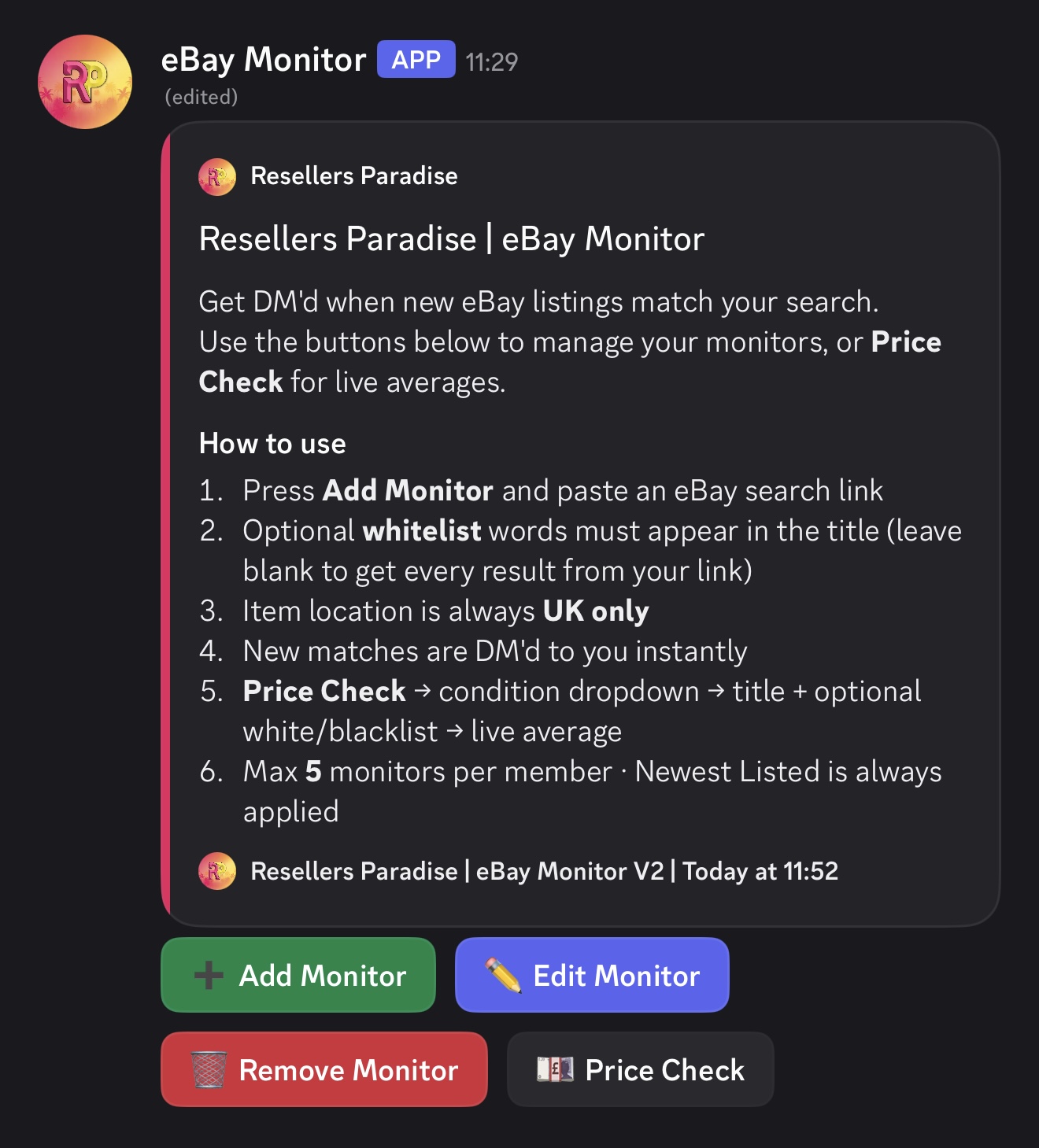
The RP eBay bot is a monitor: it tells you the second a matching item is listed. You build a search on eBay with your filters (keywords, category, price range, condition, Buy It Now or auction), paste the link in, add optional whitelist words, and every new UK listing that matches is sent to your Discord DMs, usually within seconds of going live, with a link straight to the listing. It does not bid or buy for you; you open the listing and decide. Ready-made Pokémon channels also flag listings under recent sold prices. eBay's own saved-search emails arrive in batches, often an hour or more after listing, which is why resellers use a monitor; see eBay saved search alerts and what an eBay bot is.
The Vinted bot does the same on Vinted, where the head start is bigger: alerts 4 to 7 seconds before a listing appears in the Vinted app, filters by brand, keyword, size, price ceiling and condition, and one-tap autobuy, where you decide, tap, and our system completes checkout in under a second. For a trainer or clothing reseller, Vinted is often where stock is bought and eBay where it is sold.
Both come with Resellers Paradise membership: £25 a month, everything included, cancel any time, alongside the discount monitors, the Depop monitor, the RP app and a staff team in Discord every day. Code WEBSITE takes 20% off your first month. Join once you have proved to yourself you will do the work, not before.
Frequently asked questions
Is eBay reselling still worth it in the UK?
For a beginner, yes. eBay has buyers for almost every category, not just clothes, and its sold listings show what things actually fetch before you spend anything. Our estimate for a few hours a week of flipping is £100 to £300 a month after fees, and past £1,000 a month for members who treat it as a part-time job with tools. The trade-offs are crowded categories, business seller fees once you are trading, and returns.
Do I need a business account to resell on eBay UK?
A private account is for selling your own belongings. Once you buy stock to sell on, you are trading, and eBay expects that on a business account, which has different fees and consumer-law obligations. Checked October 2026: UK private sellers pay no final value fee outside vehicles and get 300 free listings a month; business sellers pay a percentage of each sale that varies by category plus a small per-order fee. Check the official fee pages before choosing.
How much money do I need to start reselling on eBay?
Nothing at first, because the first stock is what you already own. Once you have made a few sales and understand pricing, £50 to £100 of stock money from charity shops, car boots and underpriced listings is enough. Reinvest the profit rather than adding cash until you have sold what you bought.
What sells best on eBay for beginners in the UK?
Start with what you already know, because knowledge is how you spot a mispriced item. Beyond that: trainers, electronics accessories like controllers and chargers, video games, collectables such as Pokémon cards and LEGO, and bundles you can split into separate listings. They have clear sold prices, steady demand and cheap postage.
How do I find out what something sells for on eBay?
Search for the item on eBay, open the filters and tick Sold items. Look at the last several sales in the same condition as yours, ignore the highest, and price near the middle. Then take off fees, postage and packaging and your purchase price; what is left is the profit. Resellers Paradise members can also run a Price Check command in Discord that returns the live average sold price by condition.
Do I pay tax on eBay reselling in the UK?
Selling your own unwanted belongings is not trading and is not taxed. Buying to sell on is. You get a £1,000 trading allowance each tax year; under it you owe nothing and do not need to tell HMRC. Above it you register for Self Assessment by 5 October after the end of the tax year, and tax is on profit: sales minus stock, fees, postage and tools. Since 2024 eBay reports sellers to HMRC once they pass 30 sales or around £1,700 in a calendar year. Being reported is not a tax bill.
Sources
- eBay UK, Fees for private sellers. Checked October 2026.
- eBay UK, Fees for business sellers. Checked October 2026.
- eBay UK, Buyer Protection fee. Checked October 2026.
- HMRC, Tax-free allowances on property and trading income.
- HMRC, Selling goods or services on a digital platform.
- Earnings figures are our estimates from member experience, not survey data. Member results are self-reported in the Resellers Paradise Discord with screenshots.
Ready to start reselling on eBay?
Join 1,500+ members using the eBay monitor, Vinted bot, discount monitors and the RP app.
Use code WEBSITE for 20% off your first month.