
Underpriced eBay listings exist because sellers make mistakes: a misspelt brand, the wrong category, one dark photo, a Buy It Now price set from memory rather than from sold listings. You find them by searching for the mistake rather than for the item, checking what it actually sells for before you pay, and being quicker than the other people doing the same thing. That last part is where most resellers lose, because a mispriced Buy It Now can be gone within minutes.
This guide covers why listings end up cheap, the manual ways of finding them, how to check value and fees first, the maths of a flip, the traps, and how a monitor like the RP eBay bot changes the speed side. New to reselling? Start with our guide to reselling in the UK and the step-by-step starter page.
Why underpriced listings exist
Every cheap listing is cheap for a reason. The good reasons all come down to the seller making the listing hard to find or hard to trust, so fewer buyers see it.
- Misspelt titles. "Addidas", "Ralph Loren", "Nintendo Swich". Nobody searching the correct spelling sees these, so they sit for days.
- Wrong category, or no brand in the title. A Barbour jacket under Women's Coats, or "mens green wax coat large" with the brand only visible in the photo.
- Sellers clearing house. Someone emptying a parent's home wants it gone this week, not top price. They list in bulk, price low, and often say so: "house clearance", "need gone".
- No photos or bad photos. One blurry picture in a dark room puts off most buyers. If the title and description tell you exactly what it is, a bad photo is a discount.
- Auctions started low at the wrong time. A 99p start only works for the seller if enough bidders find it. A badly titled auction listed late on a Sunday night with one photo can end a week later with two bids.
- Job lots and bundles. Ten items at one price. Most buyers want one thing and skip bundles, so the per-item price is often well under what each piece sells for alone. The margin is in splitting the lot.
- Buy It Now set below sold prices. The seller guessed, copied an old listing, or does not know prices have moved. These go fastest because every reseller watching the category wants them.
Notice the split. The first four types sit for days because they are hard to find. The last three are visible to everyone and go within minutes, so speed decides.
The manual methods and their limits
The table is our view of what each manual method finds, how quickly you see a listing with it, and what it costs you in time.
| Method | What it finds | How fast you see it | Effort |
|---|---|---|---|
| Sold and completed filter | Not listings, but what they are worth. The step before every purchase. | Instant, any time | Two minutes per item |
| Misspelling searches | Listings nobody searching the right spelling will see | Whenever you search; these sit for days | Build a spelling list once, run it weekly |
| Newly listed sort | Fresh Buy It Nows priced below sold prices | Only as fast as you refresh | High and constant; you are the monitor |
| Local collection only | Bulky items with few bidders: furniture, exercise kit, large electronics | Auctions run for days; Buy It Nows sit | Driving, lifting, storage |
| Category browsing | Wrong-category and vague-title listings that keyword search misses | Slow; you scroll pages | High; only pays in a niche you know |
| eBay saved searches | Keyword matches, emailed to you | Batched, often an hour or more after listing | Low once set up |
Misspelling searches are the best manual method for the listings that sit. Write down every way your niche's brands get mangled and search them in one go: eBay accepts several terms in brackets separated by commas, so (addidas, adiddas, adiads) is one search. The limit is that everyone who has read a guide like this runs the same spellings.
Newly listed sort is how you catch Buy It Nows under sold prices by hand. Set your search, sort by Newly Listed, refresh. It works and it is exhausting, because the listing goes to whoever refreshed most recently, and you cannot do it at work or asleep. This is the gap monitors fill.
Local collection only removes every buyer who will not drive, so a cross trainer in a town with few resellers often ends an auction at a fraction of its value, if you have a car and storage. Category browsing only pays in a niche you know, because the point is spotting a £120 jacket in a listing that calls it a "coat". Look at photos, not titles.
eBay's own saved searches are the cheapest option and the slowest. The emails arrive in batches, often an hour or more after the listing went live: fine for a collector, useless for a £28 jacket that twenty other people want. More in eBay saved search alerts.
How to check what something is worth before you buy
An asking price tells you nothing. Four checks before you pay for anything.
1. Sold listings. Search the exact item, open the filters, tick Sold items. Look at the last ten to twenty sales in the same condition and completeness, and take the middle of the range, not the top. Sold prices on listings from UK private sellers include the buyer protection fee, so the seller received a little less than the number you see.
2. Condition. Read the whole description, including the last paragraph where "small mark on sleeve" and "no power cable" live. A listing marked used with box-fresh stock photos is a flag.
3. Postage, both ways. What you pay to get it to you, and what it costs to send on. A £2 item with £15 postage is a £17 item.
4. Fees. Checked October 2026 against eBay's official pages, linked in the sources. UK private sellers pay no final value fee on most sales; vehicles and listings beyond 300 a month are exceptions. Buyers pay a buyer protection fee when buying from UK private sellers, built into the price shown: £0.10 per item plus 7% of the price up to £20, 4% of the portion from £20 to £300 and 2% of the portion from £300 to £4,000. Business sellers pay a final value fee that varies by category (11.9% in Clothes, Shoes and Accessories, for example) plus £0.40 per order over £10 and a 0.35% regulatory operating fee. If you buy to sell on, eBay's business seller rules and HMRC's view of trading both apply to you: see our eBay fees UK breakdown and check the official pages before relying on any figure.
RP members have two shortcuts: the Price Check command in Discord, which takes a condition and the item title and returns a live average sold price, and the RP app, which tracks purchase price, sale price, fees and postage per item so you know what each flip actually made.
The maths of a flip: a worked example
The numbers below are our estimate for a typical listing, not a real sale. Use the method, not the figures.
A seller clearing a house lists a men's Barbour wax jacket as "mens green wax coat size large", no brand in the title, one photo, £28 Buy It Now plus £4.50 postage. You recognise the model from the photo.
- What it sells for. Sold listings for that model, used, same size: our estimate is £80 to £95, so plan on £85.
- Cost to buy. £28 plus £4.50 postage is £32.50. The £28 already includes the buyer protection fee.
- Cost to sell. About £1 for packaging. You charge the buyer £4.50 postage, which is what it costs you, so postage out is neutral.
- Fees as a private seller. None on the sale (checked October 2026). Profit: £85 minus £32.50 minus £1, roughly £51.
- Fees as a business seller. The final value fee is charged on the total including postage: 11.9% of £89.50 is £10.65, plus £0.40 per order and £0.31 regulatory fee, about £11.36. Profit: £89.50 in, minus £32.50, £4.50 postage, £1 packaging and £11.36 fees, roughly £40.
- Time and risk. Ten minutes to list, five to pack, a trip to the drop-off. It may sit unsold for a fortnight or come back as a return.
Turn that into a rule and you stop deliberating: buy only when sold price, minus fees, minus postage both ways, minus the profit you want, is still above the asking price. If the gap is £10 on a £30 item, it is not a flip, it is a job.
Profit from flipping counts towards the £1,000 trading allowance; above that you register for Self Assessment and pay tax on profit, not sales. The tax section of our side hustle guide explains it and the side hustle tax calculator gives you your own figure.
The common traps
Fakes. Designer clothing, trainers, fragrance and trading cards attract them. The signs stack up: a new seller account, stock photos, several identical items at the same "too good" price, a graded card with no clear photo of the slab. Ask for extra photos; if the seller will not send them, that is your answer. A refund weeks later is not the flip you wanted.
Sellers who cancel. A private seller who realises they listed too cheap can cancel your order. You are refunded in full, including the buyer protection fee, and that is about all that happens. Expect it on a share of the best deals. Do not argue in messages; leave accurate feedback where eBay allows it and move on.
Cheap for a reason. "Untested", "spares or repair", "no charger" and "collection only" are fine when you know the category and have priced the risk, and expensive when you have not. An item located abroad can carry import charges the price does not show. A reproduction is often described honestly in the fourth paragraph and nowhere else.
Buying everything that looks cheap. Twenty £15 bargains that each take a month to sell is £300 you cannot use on the one listing that would have paid the month. Sell before you buy more.
Forgetting the exit. Something underpriced on eBay is not always best sold back on eBay. Clothing often does better on Vinted and streetwear on Depop; our eBay vs Vinted vs Depop comparison covers where each category sells.
Where a monitor changes the speed side
Go back to the split. Misspellings, wrong categories and bad photos sit for days, so the manual searches find them. Buy It Nows under sold prices and good job lots go to the first person to open the listing and pay, and by hand your only tool for that end is Newly Listed and a refresh button.
That is what the RP eBay monitor is for. You build a search on eBay with every filter you want (category, condition, price range, Buy It Now or auction, free postage), paste the link into the monitor in Discord, and add optional whitelist words that must appear in the title. Every new UK listing that matches is then sent to your Discord DMs, usually within seconds of going live, with the photo, the price, a link to eBay's sold prices for the same item and a button to open the listing. Each member can run up to five monitors, and shared Pokémon channels compare every new singles or sealed listing to recent sold prices and flag the percentage under market.
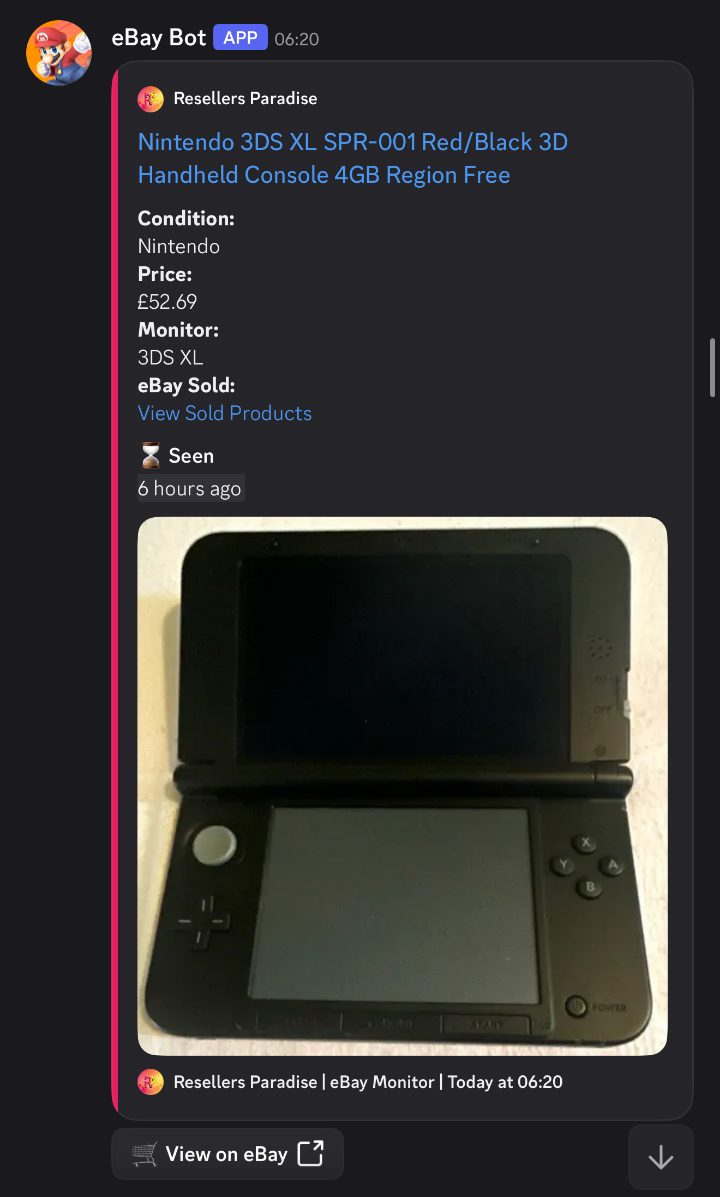
Two honest limits. The monitor does not bid or buy for you: it tells you, you open the listing and decide. eBay has no equivalent of the one-tap autobuy on our Vinted bot, and we do not offer one. And we make no claim of a head start over the eBay app itself: the advantage is that you are not refreshing, your filters are sharper than eBay's, and the listing reaches you when it is indexed rather than in a batched email an hour later.
The setting that makes it work is the price ceiling. Take the sold price from Price Check, subtract fees, postage and the profit you want, and set that as the maximum in your eBay search link. Then everything that arrives is underpriced on paper. What an eBay bot is covers the setup, the free live Vinted monitor shows the same idea running on Vinted, and membership is £25 a month, everything included, cancel any time.
Putting it together
Pick one niche you can price without looking it up. Run a misspelling search weekly for the listings that sit, and a monitor, or Newly Listed and your thumb, for the Buy It Nows that go fast. Check sold prices before every purchase and only buy when the margin survives fees and postage. Our eBay reselling for beginners guide covers the selling side once you have the stock.
Frequently asked questions
How do you find underpriced items on eBay?
Search for the seller's mistakes rather than for the item: misspelt brands, vague titles, the wrong category, job lots and house clearance listings. Sort by Newly Listed for Buy It Nows priced below sold prices, because those go within minutes. Check sold listings before you pay and subtract fees and postage. For the fast end, a monitor like the RP eBay bot sends matching new listings to Discord within seconds.
Is eBay flipping still worth it in the UK?
Yes, if you know your niche and check sold prices before every purchase. Margins on a single flip are modest after postage and fees, so it works as a habit: a few checked purchases a week in a category you understand. More people watch the same searches than a few years ago, which is why resellers use monitors for time-sensitive listings and manual searches for the ones that sit.
What fees do I pay when I flip on eBay in the UK?
Checked October 2026: UK private sellers pay no final value fee on most sales. Buyers pay a buyer protection fee on purchases from UK private sellers, built into the price shown: £0.10 per item plus 7% up to £20, 4% from £20 to £300 and 2% from £300 to £4,000. Business sellers pay a final value fee by category, for example 11.9% in Clothes, Shoes and Accessories, plus £0.40 per order over £10 and a 0.35% regulatory fee. Check eBay's official pages before relying on any figure.
How do I know what something will sell for on eBay?
Search the exact item, open the filters and tick Sold items. Look at the last ten to twenty sales in the same condition and completeness and take the middle of the range, not the highest. Sold prices on private listings include the buyer protection fee, so the seller received slightly less than shown. RP members can also use the Price Check command in Discord for a live average sold price by condition.
Does the RP eBay bot find underpriced listings automatically?
It finds new listings that match a search you set up and DMs them to you in Discord, usually within seconds of going live. You build the search on eBay, paste the link, add optional whitelist words and run up to five monitors. Set the price ceiling below sold price minus fees and postage and what arrives is underpriced on paper, but you still open it and judge it. It does not bid or buy for you.
What should I do if a seller cancels after I buy an underpriced item?
Not much. A private seller who realises they listed too cheap can cancel the order, and eBay refunds you in full, including the buyer protection fee. Arguing rarely changes the outcome. Leave accurate feedback where eBay allows it and move on to the next listing. Expect it on a share of the best deals and treat it as part of the cost of hunting.
Sources
- eBay UK, Fees for private sellers: no final value fees for UK-based private sellers, excluding vehicles; checked October 2026.
- eBay UK, Buyer Protection fee: £0.10 per item plus 7% up to £20, 4% from £20 to £300, 2% from £300 to £4,000, included in the displayed price, refunded in full on a full refund; checked October 2026.
- eBay UK, Fees for business sellers: final value fees by category, per-order fee of £0.30 up to £10 and £0.40 above, 0.35% regulatory operating fee; checked October 2026.
- HMRC, Tax-free allowances on property and trading income.
- Resale values in the worked example are our estimates for illustration, not recorded sales. Details of the RP eBay monitor are from our eBay bot page.
Catch the underpriced listings before the refresh crowd
Join 1,500+ members using the eBay monitor, Vinted bot, discount monitors and the RP app.
Use code WEBSITE for 20% off your first month.